
🎣 Phishing Emails & Fake Tech Support — When Criminals Walk Through the Digital Front Door
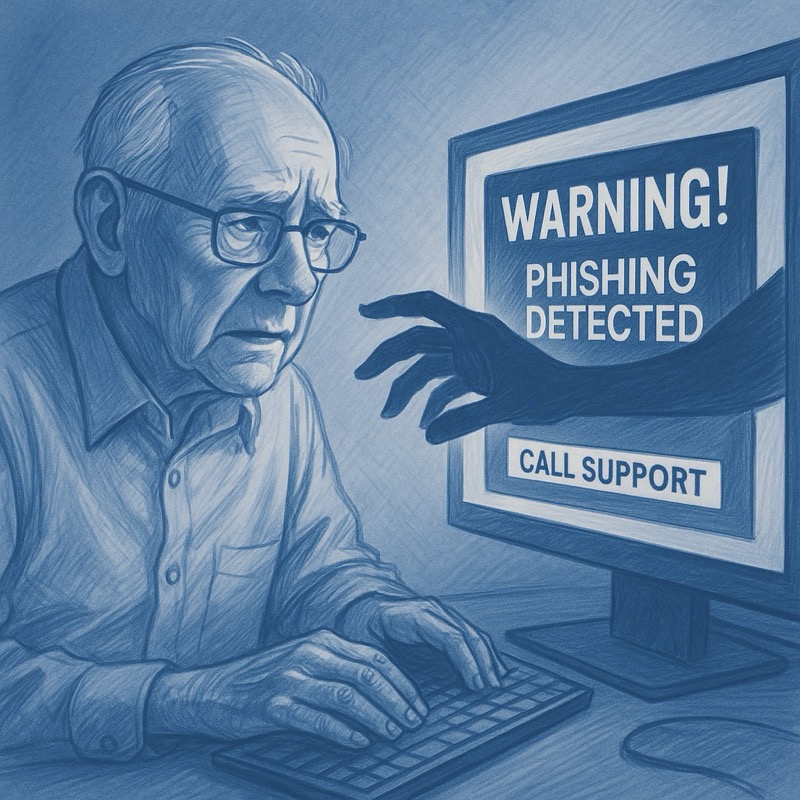
For many seniors, email still feels like mail. A message arrives → you open it → you respond. Except now the envelopes are poisoned.
It starts with something that looks official: "Your bank needs verification." "Your package is delayed." "Your account is locked — click to restore." "Microsoft detected a virus on your computer." Logos look perfect. Language looks professional. Urgency is deliberate. And with one click, the criminal is inside the home — digitally, which is often worse than physically.
👵 Why seniors fall for phishing more than anyone. Younger generations grew up with spam filters and scam warnings. Seniors were raised on trust: companies were honest, services were reliable. So when a fake email says "Your Social Security account was suspended," the fear hits instantly.
🔧 Fake Tech Support — the scam that never dies. It often begins with a popup: "WARNING: Your computer is infected. Do NOT close this window!" A phone number appears. A calm, professional voice: "Don't worry, we will fix it. Just install this program so I can help you." And that program? A remote-control tool. Once installed, the scammer can fully control your digital world. Life savings, gone in a second.
🧓 Seniors don't lack intelligence — they lack warnings. They were never taught: banks don't email links, Microsoft never calls homes, popups can be fake, "urgent" means "danger" online.
Criminals exploit this gap ruthlessly. They're not hacking devices — they're hacking instincts.
Knowledge is the first step. Protection is the second.
WhiteCat is the router that quietly enforces the boundaries you set — no arguments, no workarounds.
See Plans →